
Vintage HMS VALIANT Hallmarked Silver Small Powder Compact by E. Edmonds 1930
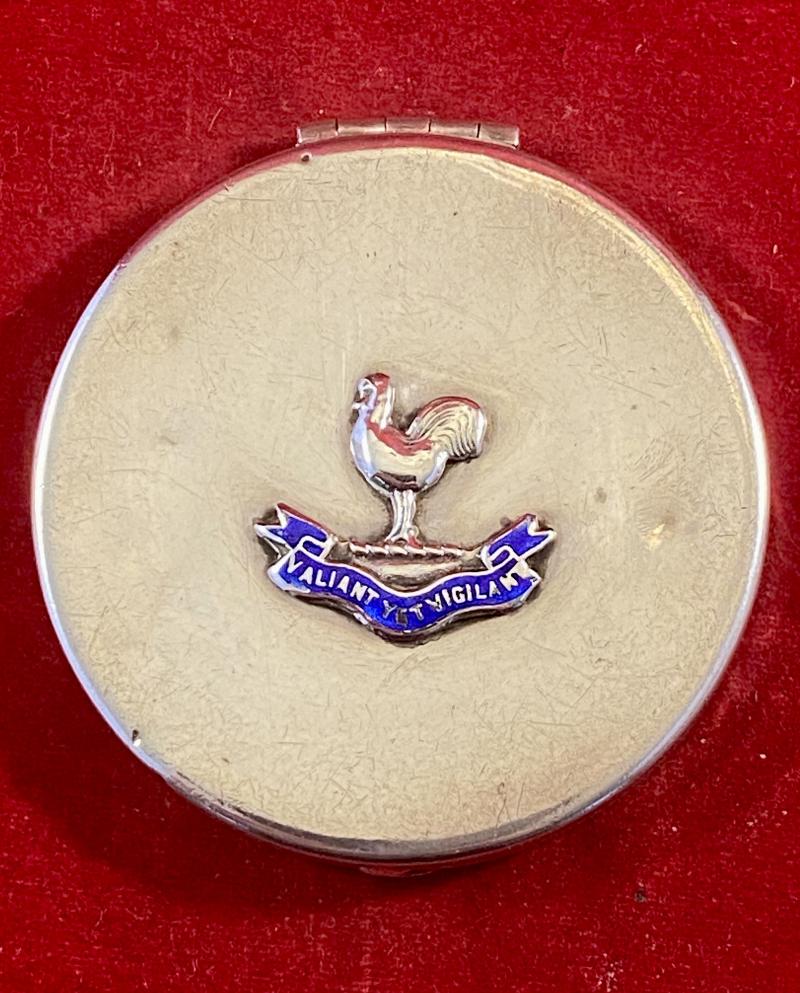
Here on offer is a vintage HMS Valiant hallmarked silver small round powder compact by E. Edmonds, dating to 1930.
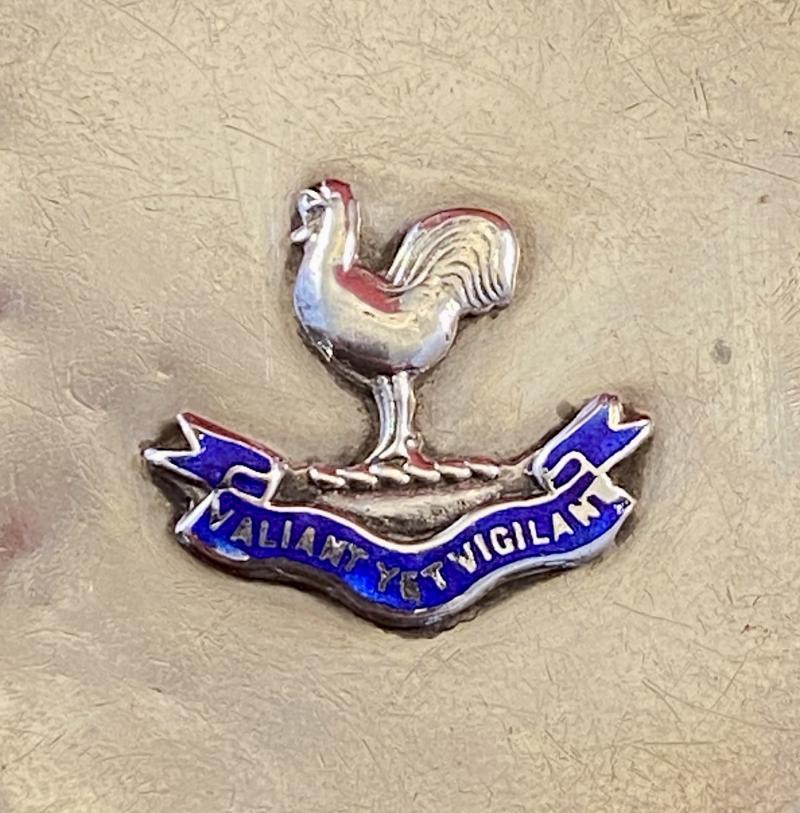
On the top of this lid, it is fitted with a raised silver and enamel “Fighting Cockerel” crest for the Royal Navy Queen Elizabeth-Class Battleship, HMS VALIANT. The ships motto “Valiant Yet Vigilant” is set in a royal blue enamel scroll ribbon, underneath the cockerel.
It was most possibly made to commemorate the re-commissioning of the ship in 1930.
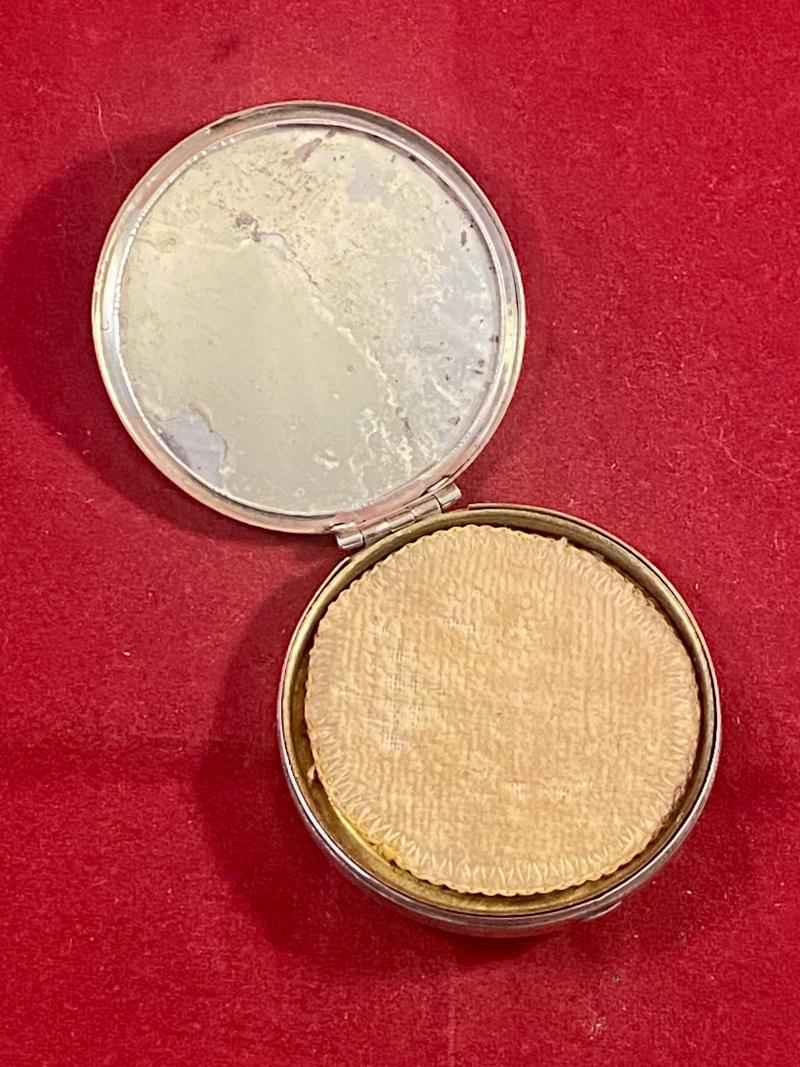
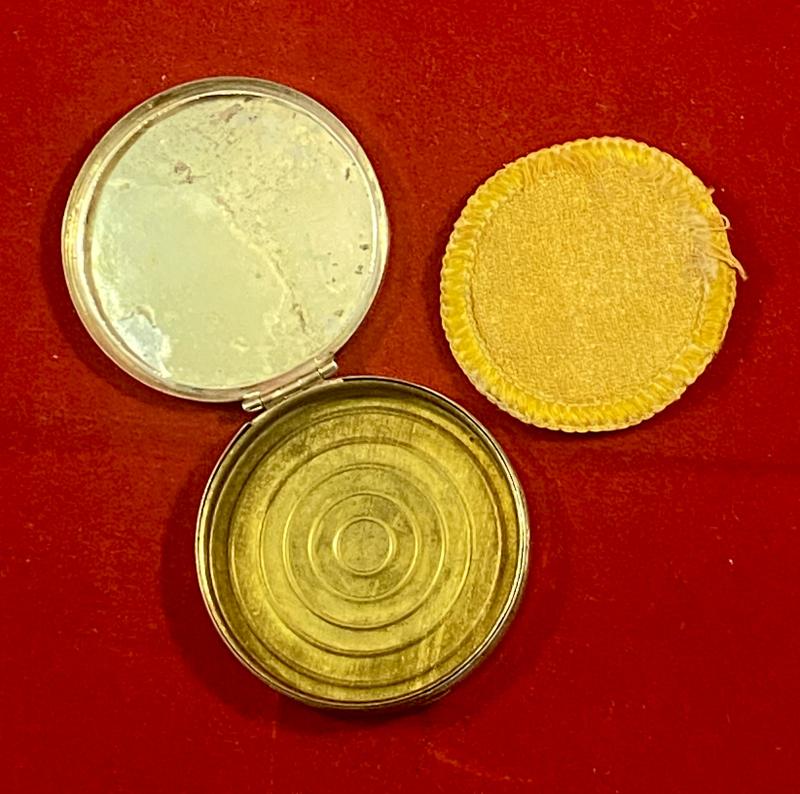
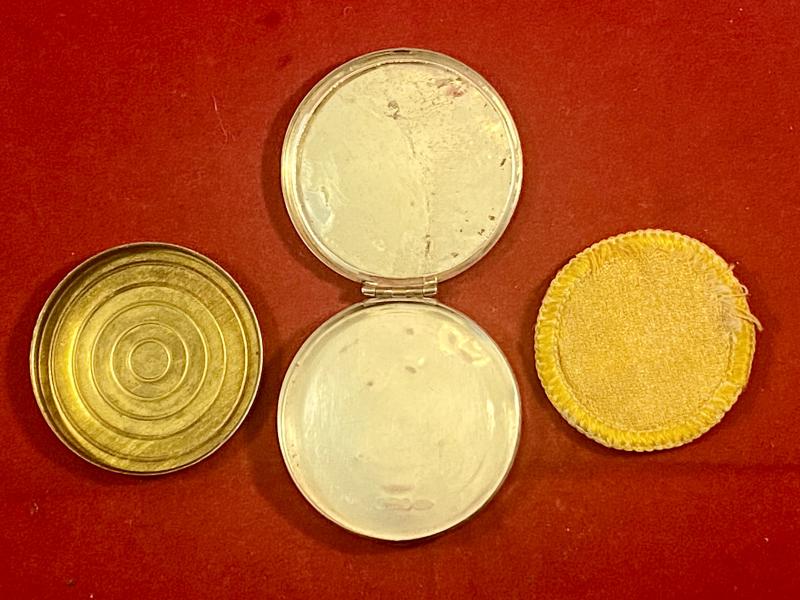
This small circular silver powder compact hinges open at the front edge. Inside the lid it is fitted with a reflective silver metallic disc that acts as a mirror.
It still retains the original gilt metal, powder disc holder and powder pad, but no powder is present.
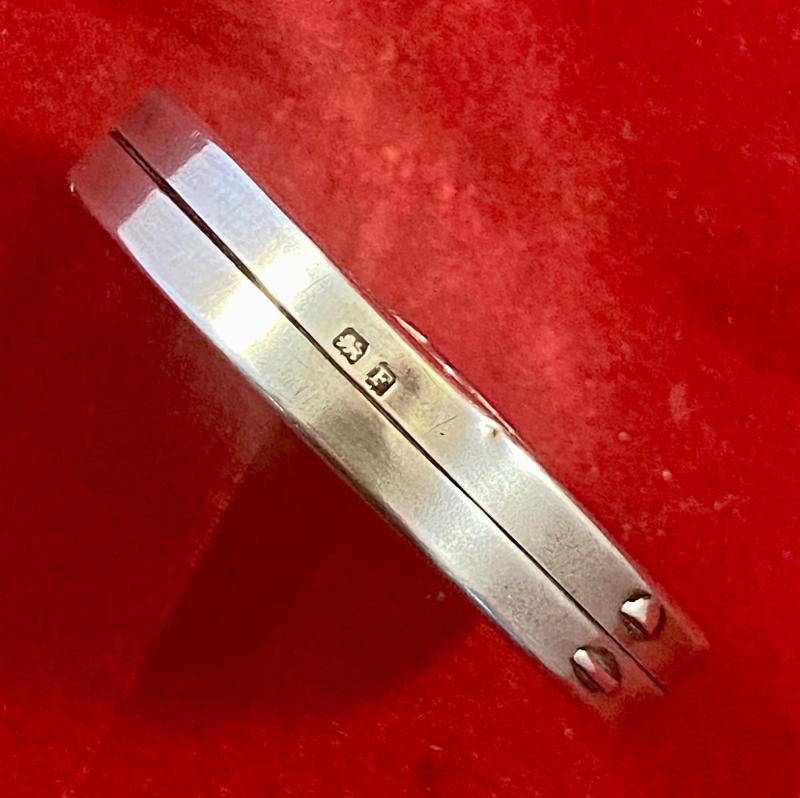
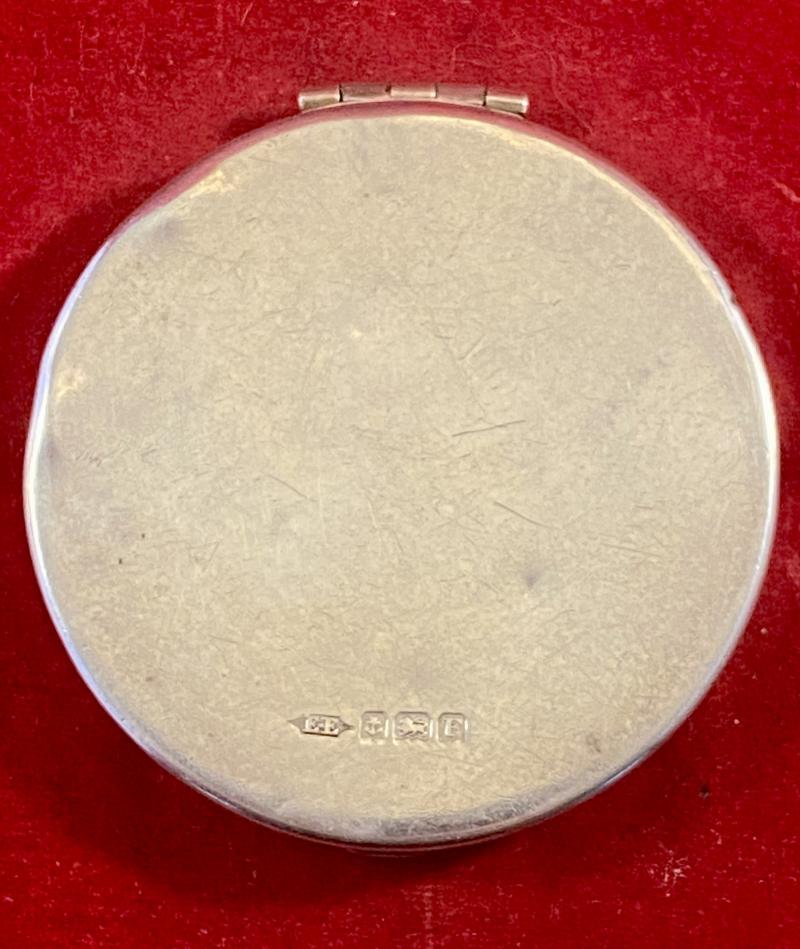
On the base are a clear set of English silver hallmarks with the maker mark.
The hallmarks are an anchor for the assay office of Birmingham, the Lion Passant for English silver and the date letter “F” for the year 1930.
There is also the makers mark “E.E” which relates to E. Edmonds of Warstone Lane, Birmingham.
It is in great condition for its age, with just some “pin head” size impressions on the lid and base. The blue enamel is in perfect condition.
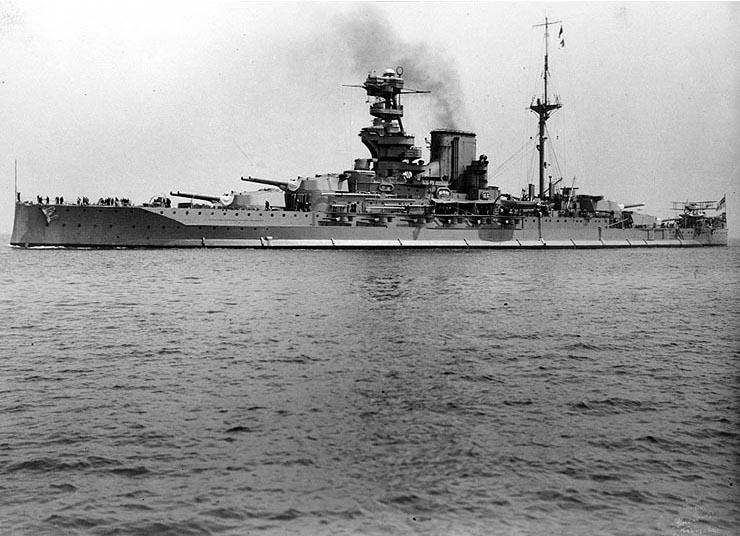
Some history about the battleship HMS Valiant.
HMS Valiant entered British Royal Navy service in 1916, initially serving with the Fifth Battle Squadron of the Grand Fleet. She participated in the Battle of Jutland later in the same year, during which she would expend 288 15-inch shells. Between 1919 and 1924, she was assigned to the 1st Battle Squadron of the Atlantic Fleet. Between 1924 and Mar 1929, she was assigned to the 1st Battle Squadron of the Mediterranean Fleet. She underwent a major refit between 1929 and 1930, during which her anti-torpedo bulges were added, her two funnels were merged into one, two of her torpedo tubes were removed, her aircraft platforms were replaced by a catapult, and she received a octuple 2-pounder anti-aircraft mounting. She returned to service in Dec 1930. In Sep 1931, her crew participated in the Invergordon Mutiny, during which her crew protested cuts in pay. Between Mar 1932 and Jul 1935, she was assigned to the Home Fleet. Between Jul 1935 and 1936, she was assigned to the Mediterranean Fleet. In 1936, she received a second octuple 2-pounder mounting. Between Mar 1937 and Nov 1939, at Devonport in Britain, she received another major refit, during which her machinery was changed to eight Admiralty 3-drum boilers with four Parsons steam turbines, her armour thickened, and she received modern fire control systems.
HMS Valiant emerged from her latest refitting after the European War had already started. Her first combat mission took her to the coast of Norway in Apr 1940. In early 1941, she bombarded Tripoli, Libya alongside of HMS Barham and HMS Warspite. Shortly after, she participated in the attack on the French fleet at Mers-el-Kébir, French Algeria and the Battle of Cape Matapan south of Greece. During the final stages of the Balkans Campaign, she was struck by two German aerial bombs off Crete, Greece in May 1941. In Dec 1941, she was seriously damaged while in harbour at Alexandria, Egypt by Italian frogman Lieutenant Durand de la Penne. Although she sank in shallow water, she remained in place for some time to provide a false impression of her active participation in this theatre of war. She was ultimate repaired in Durban, South Africa, returning to service in time to provide naval gunfire support for the Allied invasion of Sicily and then Salerno in Italy in 1943. When Italy signed the armistice with the Allies, HMS Valiant was one of the Allied warships that escorted the Italian fleet to Malta. In 1944, she was assigned to the Eastern Fleet, supporting raids against Japanese bases in the Dutch East Indies. In Aug 1944, at Trincomalee, Ceylon, she suffered some damage when the floating drydock in which she was docked suddenly collapsed; as the result of her damage, she was ordered to Alexandria, Egypt for repairs. Upon completion of repairs, she returned to Britain in 1945, and was decommissioned in July 1945 shortly before the end of the Pacific War.
She served as a stoker mechanics' training ship at the training establishment HMS Imperieuse in Devonport England. She would serve in this role until being sold for scrapping in Mar 1948.
This compact makes a great addition to any Royal Navy or compact collection.
It measures 2” (5cm) diameter and weighs 30g.
Please see my pictures for the details of the condition, which complement this description.
Please see my TERMS OF BUSINESS regarding Delivery Charges and Insurance regarding additional insurance cover, should you require it, BEFORE the item is dispatched.
The responsibility lies with the customer to check with your Customs restrictions that this item can be imported into your country.
Code: 52494
30.00 GBP